
Social measurement company Starcount has revealed the ranking
of the most popular athletes.
The company is currently charting 9,000 Olympians this year and you can narrow the search down to a country's Olympic teams, or even a specific sport. Aside from athletes, Starcount pools together the social media popularity of the most famous people from the top 11 global social networks. To read more click here. |
 |
|
Showing posts with label social media. Show all posts
Showing posts with label social media. Show all posts
Tuesday, 7 August 2012
Check out the top athletes trending on social media


Thursday, 10 November 2011
Twitter's new Activity feed
Today Twitter launched a new Facebook-style 'Activity' tab where users can view a stream of their followers' recent Twitter action. So you can see who your followers have recently followed, who they have added to lists, or what tweets they have added to their favourites.


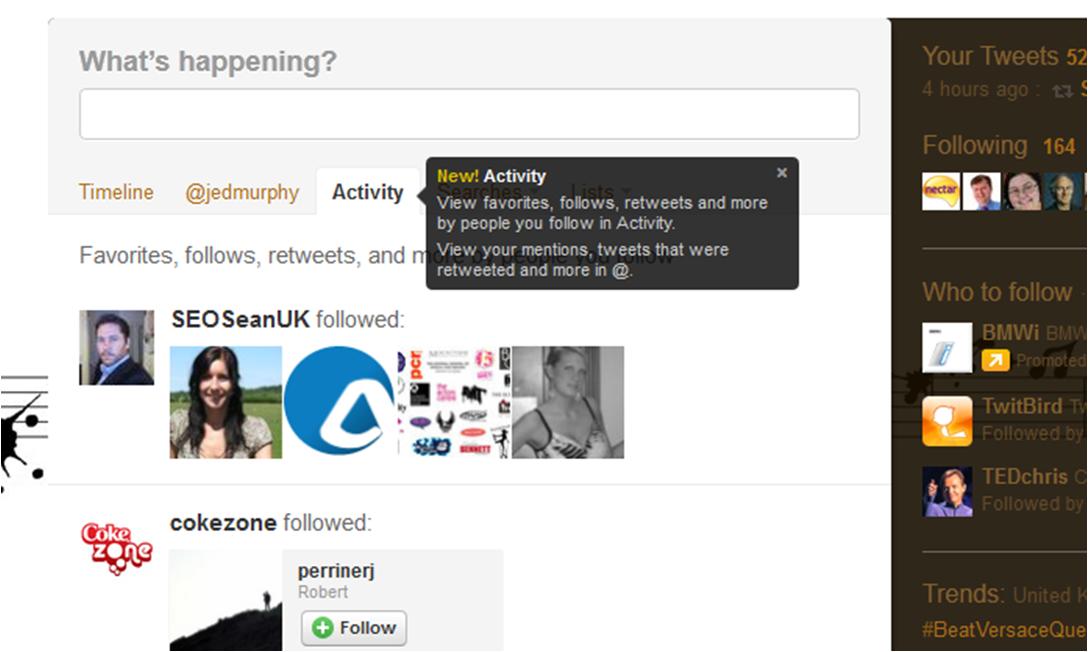
Additionally, the 'Mentions' tab has been replaced by a "@username" tab. Here users can see an activity stream of those people who have retweeted, mentioned or followed them.

The Activity tab is a neat feature that gives users a better sense of what's going on in their follower community. No doubt it's designed to ensure continued follower-growth, but it will be most useful for brands & businesses. It will give brands extra reach because every time they are followed the 'Activity' tab allows a much wider audience to be exposed to that brand interaction and to potentially follow that brand themselves.
Sunday, 11 September 2011
Facebook introduces Smart Lists to compete with Google+ Circles
You may have noticed when logging into Facebook recently that it's added functionality to the way that users can update their Status. The Status box now includes options for location, friends names and additional control over which friends get to see different status updates. Now some of this functionality was already available on Facebook - but this revision to the Status box makes it easier to control these features.

Additionally, Mashable this week also revealed some screen shots of Facebook's new Smart Lists. This will automatically group friends into one of three categories: 'work colleagues', 'old classmates' and those 'that live within 50 miles' of you. This is intended to mirror the Google+ Circles so that the user can more easily choose how to share information with different groups of contacts.

Users will still be able to create custom lists using an updated Friends List tool (see below).

Smart Lists are is currently limited to select users prior to its roll-out.

Additionally, Mashable this week also revealed some screen shots of Facebook's new Smart Lists. This will automatically group friends into one of three categories: 'work colleagues', 'old classmates' and those 'that live within 50 miles' of you. This is intended to mirror the Google+ Circles so that the user can more easily choose how to share information with different groups of contacts.

Users will still be able to create custom lists using an updated Friends List tool (see below).

Smart Lists are is currently limited to select users prior to its roll-out.
Monday, 18 July 2011
It’s the utility, stupid
Article first published as It's the Utility Stupid on Technorati.


Google+ is not a ‘product’ apparently. It’s still a ‘project’. And it’s out in what looks to be a limited
beta release as ‘Field Trial’ – but which feels more like a ‘throttled release’
as new users can then start to pass invites on.
Google clearly feels that this is all a work in progress.
However, it doesn’t feel like work in progress. It has hit
10m users in a few short weeks making it one of the fastest growing network
launches ever, according to Mashable.
The interface is clean and slick – and Circles makes the concept of ‘groups’
easy to implement and manage. Even the animation
when you add a friend or contact to a group is a great little piece of
interactive design.
And there are other features not found elsewhere. ‘Sparks’ looks like it could build into a
powerful content recommendation engine, especially once Google+ gains
scale. It also provides a good benefit for
users to actually ‘Google +1’ content they find or that their friends may
like. It could also be strong
opportunity to monetise the platform as brands looks to promote their own
content.

‘Hangout’s are fundamentally video chat (though trying to
get that to actually work is a little tricky) – and Facebook’s video chat via
Skype looks like it could trump that feature right off the bat.
And I suppose that’s the problem with Google+ so far. There’s no killer feature. There’s no compelling reason why this should
be my new social network of choice – no reason to give up Facebook. And I don’t need yet another network in my
life.
Even Google’s own FAQs include the question “Why don’t you
have killer feature X?”.

So far, I wager that a large proportion of Google+’s growth has
been driven by its limited access and exclusivity.
It’s the power of scarcity.
Everyone in the digerati wanted an invite and the power to
send invites. How many of Facebook’s
News Feed updates were posted from Google+ - just to demonstrate one’s own personal
sense of digital status?
But where’s Google+’s utility? Where does it add value to my
life that no other platform does? Facebook created that social utility by
connecting people with their friends - and it became the dominant social
network by doing that better than anyone else.
And it continuously evolved functionality that was useful: from pokes, picture
tagging, status updates to Like’s, Fan pages and Facebook plug-ins.
However, Facebook needs to continue being useful. As Mark Choueke says in Marketing Week, unless
it continues to evolve its utility, people will start to drift away from the
constant wall of trivial personal updates and stilted brand updates. (I’m really not sure I can take another brand
asking what I am up to for the weekend, each Friday afternoon).
There is some interesting data that shows that although Facebook
is growing globally, in some more mature markets Facebook is seeing a
decline. For example in the US
(according to Inside Facebook) it lost 6 million users during May this year and
in Canada it lost 8% of users (1.52million out of its 16.6m base).
And this trend is mirrored in the UK. According to Hitwise,
Facebook has also seen a declining market share losing ground to both Twitter
and YouTube.

Now, of course, this doesn’t for a second mean that this is
even the beginning of the end for Facebook.
But it does demonstrate the need to keep things fresh and,
most importantly, useful. It will be
interesting to see how Facebook’s Skype partnership adds to its utility and how
Google+ intends to create some significant space between it and Facebook.
Tuesday, 5 April 2011
Twitter's Facebook-style pages
 Today Twitter announced that it's considering launching Facebook-style pages.
 There's a two-fold danger.
The first is whether the strive for additional revenue streams means that Twitter starts to betray it's raison d'etre. How will Twitter pages fit with its 140 character proposition?
Secondly, Twitter pages start to become yet another property that brands feel compelled to get involved with - another platform to keep up to date and spend money on - without necessarily having thought through their objectives for them as another social media channel.
Twitter pages could easily become a brand solution in search of a brand problem.
Thursday, 31 March 2011
Google's '+1' Catch 22
 Yesterday Google announced the launch of Plus One. This will allow Google users to recommend sites and share them with friends. Clearly this is their answer to Facebook's ubiquitous 'Like' button. It's yet another foray for Google into social media territory after the disappointments of both Buzz and Wave.
Google's +1 button will be placed on their search results and even on publisher's/content pages. However the key question is how and where that recommendation is shared?
Google have said that initially +1 will only be accessible to a small proportion (c2%) in the US and that logged-in Google users will be able to share their recommendations via Gmail, Good Reader and Buzz.
But that, by default, limits both its appeal and its audience. Apparently a integration with Twitter is on the cards - but Google seem tight lipped about Facebook integration.
And that's the key issue - Facebook has become such a dominant platform that other social media tools need to plug into it to drive scale quickly. Just look at Path one of the newest entrants into the social networking space - they rapidly had to use Facebook integration to spread the word and bring in new users to their platform.
Additionally Facebook's 'Like' function has evolved over the last few years and drives user interaction at a number of levels - creating Fans for pages plus driving content sharing via a user's Newsfeed. Will +1'ing (terrible verb!) really be a useful interaction for a user?
+1 on it's own won't make Google's Buzz a credible social platform, and without a credible social platform what's the point of it?
Wednesday, 19 May 2010
Facebook's privacy issues will be its downfall
Sparked most by some of the changes announced at the Facebook F8 conference the last couple of weeks have seen another flurry of comment and debate on Faceboook's privacy changes.
Search Engine Land recently stumbled across the fact that that typing "how do I" into Google now brings up "how do I delete my Facebook account" as one of the top searches.

They also illustrate the increased search volumes for people wishing to delete their Facebook account.

Andrew Brown's blog on the Guardian website makes the excellent point that if people think that they are Facebook's customers they are very much mistaken. People are Facebook's product and it is the advertisers who constitute Facebook's customers. Now Facebook is a commercial organisation and, in order to maintain a free service for members, there really is only an advertising model at their disposal to generate revenue. I don't think many people would argue with that. The key issue is the way in which member's data and privacy has been eroded over time through numerous privacy changes that been have less-than-transparent to members. What most angers Facebook users is that with each new update the default Facebook privacy settings work in the favour of the advertiser and against the privacy of the user.
Andrew Brown points to a great graphic on The New York Times' website that illustrates the complexity of privacy options that Facebook users now need to navigate through together with the every-lengthening privacy policy itself. Some of these automatic opt-ins appear to contravene UK data protection legislation.

As a result there is a growing interest in alternative social networking models whereby the network's members have greater control of their data. One site receiving some attention is Diaspora. Diaspora defines itself as a privacy aware, personally controlled, distributed open source social network. The development team behind Diaspora are four New York University students. They claim that because social networking has only been around for the latter half of the decade we are yet to fully understand the privacy implications of providing personal information to a central 'hub' (such as Facebook) that then facilitates communications and content between people. Diaspora is different because as a peer-to-peer network each user runs their own 'node' (called a 'Seed') within the Diaspora network. As a result, the user retains ownership and control of their data.
However the fundamental question remains: how will Diaspora make money? Without a subscription or licence fee for users the only realistic option is an advertiser-funded model The temptation for the Diaspora team will surely be the same as currently facing Facebook: how to serve the needs of the advertiser to maximize revenues.
Concerns over privacy issues may well start people rethinking their need for a Facebook account - but whether an alternative model exists remains to be seen.
Diaspora launches this September.
Search Engine Land recently stumbled across the fact that that typing "how do I" into Google now brings up "how do I delete my Facebook account" as one of the top searches.

They also illustrate the increased search volumes for people wishing to delete their Facebook account.

Andrew Brown's blog on the Guardian website makes the excellent point that if people think that they are Facebook's customers they are very much mistaken. People are Facebook's product and it is the advertisers who constitute Facebook's customers. Now Facebook is a commercial organisation and, in order to maintain a free service for members, there really is only an advertising model at their disposal to generate revenue. I don't think many people would argue with that. The key issue is the way in which member's data and privacy has been eroded over time through numerous privacy changes that been have less-than-transparent to members. What most angers Facebook users is that with each new update the default Facebook privacy settings work in the favour of the advertiser and against the privacy of the user.
Andrew Brown points to a great graphic on The New York Times' website that illustrates the complexity of privacy options that Facebook users now need to navigate through together with the every-lengthening privacy policy itself. Some of these automatic opt-ins appear to contravene UK data protection legislation.

As a result there is a growing interest in alternative social networking models whereby the network's members have greater control of their data. One site receiving some attention is Diaspora. Diaspora defines itself as a privacy aware, personally controlled, distributed open source social network. The development team behind Diaspora are four New York University students. They claim that because social networking has only been around for the latter half of the decade we are yet to fully understand the privacy implications of providing personal information to a central 'hub' (such as Facebook) that then facilitates communications and content between people. Diaspora is different because as a peer-to-peer network each user runs their own 'node' (called a 'Seed') within the Diaspora network. As a result, the user retains ownership and control of their data.
However the fundamental question remains: how will Diaspora make money? Without a subscription or licence fee for users the only realistic option is an advertiser-funded model The temptation for the Diaspora team will surely be the same as currently facing Facebook: how to serve the needs of the advertiser to maximize revenues.
Concerns over privacy issues may well start people rethinking their need for a Facebook account - but whether an alternative model exists remains to be seen.
Diaspora launches this September.
Thursday, 10 December 2009
Facebook mishandles privacy update
 Last week Facebook rolled-out a new set of privacy settings. If you're a Facebook user you can't really have missed it. You were forced to at least review the settings when you logged-in.
It was billed as putting the user in greater control of their data and the information that they share with others, with advertisers and with 3rd party applications.
However, after many months of critical speculation and reassurance that Facebook was taking privacy seriously, it appeared that some of the new default settings automatically made personal information available to more, rather than fewer, people (irrespective of one's previous settings). For example the default setting for member photos and birthdays used to be limited to 'friends' however, the new default setting extends this to 'friends of friends'.
It's not all bad news, however. Where a user wants to review and adjust their privacy settings the new Facebook controls allow customisation of almost every element including what information is shared by applications.
We all understand that Facebook has to evolve its business model. Its core asset is the data it holds on its members. However, the fear now is that to drive advertising growth it will start to push members into sharing more than they want (or more than they thought they had shared) simply because most users simply won't want to spend the time adjusting complicated settings, or they simply don't understand the implications.
However, as both behavioural targetting and social search become the new battlegrounds for both social networking sites and the major search engines - understanding what personal information is accessible by whom will become increasingly important.
Wednesday, 4 March 2009
Skittles: a great idea in need of a strategy?
The new Skittles' global .com site (skittles.com) has garnered a huge amount of coverage over the last week. For those that haven't seen it yet the site has little content of it's own (simply product & content information) and instead uses iframes to publish content from Wikipedia (for the Skittles brand and company information), Facebook (the Skittles Fan page), Twitter (showing all live tweets containing the word 'skittle') and YouTube (a Skittles's channel showing advertising and user videos).
It's not unique - Modernista was playing with this a couple of years ago (modernista.com) but it is the first time that a brand has put it's global site in the hands of its consumers.
And yes, that's brave. It really shows a brand team understanding the fact that, in the world of Web 2.0, not every aspect of the brand can be controlled and managed.
Sure, there have been hiccups this week. Initially Twitter was set as Skittles' home page. However, the unfiltered feed started to contain significant amounts of bad language. Most recently the majority of feeds appeared to be marketing and sociological comments (with links to numerous blogs) on the brand strategy - rather than consumers actually discussing the product. So the home page has changed to the Wikipedia entry for Skittles.
But nevertheless the site has received an enormous amount of PR and publicity from the strategy. As Mashable says "Skittles is basically saying: "We get it. Whatever we can do cannot be as awesome as what you guys and girls can do, so we'll just link to it and let you do your thing".
So as an idea it's generated a large share of voice online. But is there really a longer term brand strategy here?
For starters to view the site the consumer needs to state their date of birth (presumably there is a minimum age restriction - but that's not made clear) - so for a youth brand a large proportion of its consumers are potentially disenfranchised from entering - unless they lie about their age - simply because bad language/adult content could be contained in the UGC.
And there are technical issues with the site. It's not accessible (it requires the Flash plug-in and there is no HTML alternative). From a usability perspective the floating menu system obscures the screen and readability of the content behind.
But the biggest issue is simply this - what exactly is the longer term strategy? Ok, consumers may come today based on the hype. But what's going to bring them back? And when they are on the site - are they having a brand experience that builds brand equity or are they participating in a social media experiment?
Time will tell.
It's not unique - Modernista was playing with this a couple of years ago (modernista.com) but it is the first time that a brand has put it's global site in the hands of its consumers.
And yes, that's brave. It really shows a brand team understanding the fact that, in the world of Web 2.0, not every aspect of the brand can be controlled and managed.
Sure, there have been hiccups this week. Initially Twitter was set as Skittles' home page. However, the unfiltered feed started to contain significant amounts of bad language. Most recently the majority of feeds appeared to be marketing and sociological comments (with links to numerous blogs) on the brand strategy - rather than consumers actually discussing the product. So the home page has changed to the Wikipedia entry for Skittles.
But nevertheless the site has received an enormous amount of PR and publicity from the strategy. As Mashable says "Skittles is basically saying: "We get it. Whatever we can do cannot be as awesome as what you guys and girls can do, so we'll just link to it and let you do your thing".
So as an idea it's generated a large share of voice online. But is there really a longer term brand strategy here?
For starters to view the site the consumer needs to state their date of birth (presumably there is a minimum age restriction - but that's not made clear) - so for a youth brand a large proportion of its consumers are potentially disenfranchised from entering - unless they lie about their age - simply because bad language/adult content could be contained in the UGC.
And there are technical issues with the site. It's not accessible (it requires the Flash plug-in and there is no HTML alternative). From a usability perspective the floating menu system obscures the screen and readability of the content behind.
But the biggest issue is simply this - what exactly is the longer term strategy? Ok, consumers may come today based on the hype. But what's going to bring them back? And when they are on the site - are they having a brand experience that builds brand equity or are they participating in a social media experiment?
Time will tell.
Monday, 23 February 2009
Should brands pay to Twitter?
There's been a lot of discussion this week on rumours that Twitter is considering charging brands to get involved with the platform.
Twitter is an innovative way to communicate with customers, but, as a paid-for communications vehicle, the returns are untested. There are many other proven digital channels that would take priority in a brand’s marketing budget.
Twitter’s dilemma is creating a business model and beginning to repay its initial $20m venture capital investment. To start by charging brands a subscription seems counter intuitive. Firstly, there’s the whole area of enforcement - how would brand involvement be policed? And, secondly, will enough brands get involved to create a sustainable business model?
Twittering takes a larger investment than the subscription cost - there’s the continual demand for content creation, and reaction to ‘Tweets’ that have a direct cost for brands.
A better approach would be for Twitter to monetise its site traffic through online advertising, or search, in a similar way to Facebook. Then it could allow brands that want to Tweet to continue their involvement, and prove the effectiveness of Twitter as its user base grows.
Introducing a paid-for-subscription service once the brand case has been made seems a wiser option.
Twitter is an innovative way to communicate with customers, but, as a paid-for communications vehicle, the returns are untested. There are many other proven digital channels that would take priority in a brand’s marketing budget.
Twitter’s dilemma is creating a business model and beginning to repay its initial $20m venture capital investment. To start by charging brands a subscription seems counter intuitive. Firstly, there’s the whole area of enforcement - how would brand involvement be policed? And, secondly, will enough brands get involved to create a sustainable business model?
Twittering takes a larger investment than the subscription cost - there’s the continual demand for content creation, and reaction to ‘Tweets’ that have a direct cost for brands.
A better approach would be for Twitter to monetise its site traffic through online advertising, or search, in a similar way to Facebook. Then it could allow brands that want to Tweet to continue their involvement, and prove the effectiveness of Twitter as its user base grows.
Introducing a paid-for-subscription service once the brand case has been made seems a wiser option.
Subscribe to:
Posts (Atom)

 Posts
Posts


